
Relevant European Policy Documents
Discover key European guidance
The following policy documents at EU and Council of Europe level provide the key political framework for education on democratic participation, common values, and human rights in Europe. They demonstrate that our work and the approaches presented in this toolkit are firmly grounded in existing European strategies, recommendations, and resolutions. In this way, the toolkit supports users in developing their practice in alignment with current EU and Council of Europe initiatives promoting democratic education and active citizenship.

Why this matters for teachers
- Connects classroom practice with widely shared European values such as democracy, human rights, inclusion, and the rule of law
- Provides a strong policy foundation for teaching citizenship, critical thinking, and participation
- Helps schools align their educational work with European priorities while strengthening students’ sense of belonging and active engagement
The following key documents provide the European policy context for education for democratic citizenship and common values.
EU level
Click ob “+” to read more.
The Recommendation aims to promote a sense of belonging – conveying common values, practicing inclusive education, and teaching about Europe and its Member States to help increase a sense of belonging to one’s school, locality, country, as well as the European family.
The European Commission works with EU Member States to support and reinforce the development of key competences and basic skills for all, from an early age and throughout life. Identifies “citizenship competences” as a key competence; includes understanding EU common values, awareness of national/European/global developments, European integration, cultural diversity, and how national identities contribute to a shared European identity.
Strategic framework supporting youth in becoming active citizens through Erasmus+ and ESC.
The 6 April 2022 European Parliament resolution on the implementation of citizenship education (2021/2008(INI)) calls for a stronger, more harmonized approach to teaching democratic values, human rights, and the EU’s role across member states. It emphasizes fostering critical thinking, media literacy, and active participation in civic life to strengthen European identity.
The 2023 Council conclusions on education and training for common European values and democratic citizenship emphasize strengthening EU democratic resilience amidst crises by prioritizing citizenship education, critical thinking, and media literacy. It calls for fostering a shared sense of belonging and promoting, at all levels, the values of freedom, equality, and the rule of law.
Key document on Council of Europe level
Click ob “+” to read more.
The Charter is a policy framework that defines how education should promote democratic values, human rights, and the rule of law, while preventing discrimination, intolerance, violence, and extremism. It states that education for democratic citizenship and human rights should cover all areas of life and forms of learning, empowering people to participate actively, responsibly, and respectfully in a diverse democratic society. Furthermore, it calls on Council of Europe member states to align policies, curricula, and educational practices in order to implement these goals in a systematic and sustainable way.
Educational tip for this section
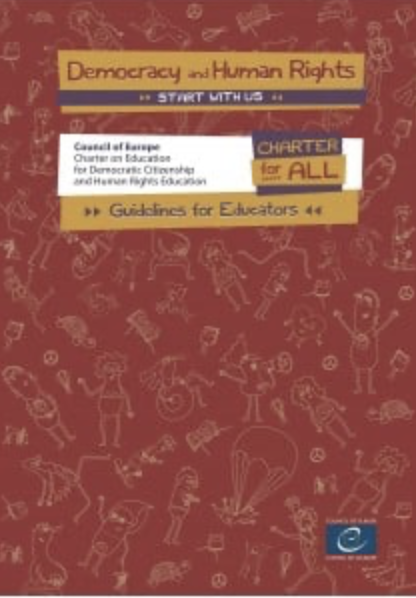
Human Rights and Democracy Start with Us – Charter for All
With the brochures on the Charter on Education for Democratic Citizenship and Human Rights Education, the Council of Europe has created a pool of resources that supports engagement with this important foundational document in the classroom. It is the only teaching material that takes a policy document on citizenship education as its subject and is also suitable for younger children. It offers an engaging and innovative pedagogical approach. The brochures, posters and the guidelines for educators are available in various languages.